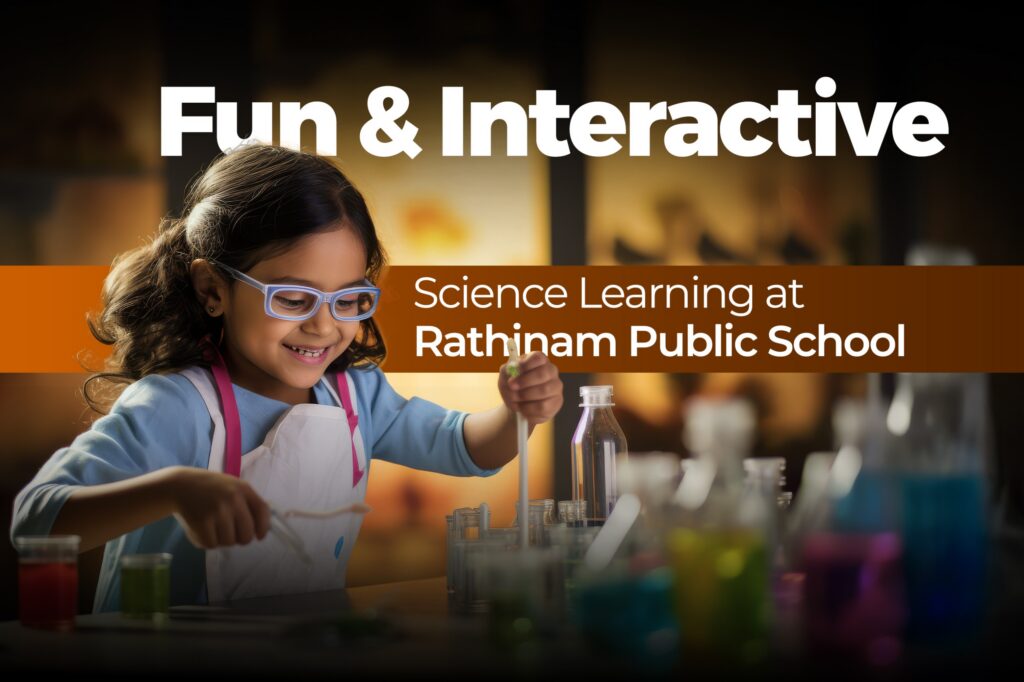
The science curriculum at Rathinam Public School (RPS) not only covers the theory from the textbook but the process of observation, questioning, experimentation and discovery. This makes each session of science at RPS very much interesting.
Students learn to develop scientific thinking as they build their confidence and creativity and problem solving skills, through simple classroom projects to STEM based projects. The experiential approach is consistent with RPS’s overall learning philosophy that combines academics with innovation, creativity and life skills.
Why Science Learning Matters in Today's World
Science is there in every aspect of daily life from the food we eat and the technology we use to the environment we live in. Early scientific knowledge development helps pupils to:
- Be logical & analytic
- Solve real-life problems
- Make informed decisions
- Develop curiosity and innovation
- Understand environmental sustainability
The RPS Approach to Science Education
RPS uses an activity-based and experiential learning approach where students are encouraged to learn through activities rather than memorizing.
Learning Beyond Textbooks
Students participate in:
- Classroom experiments
- Science demonstrations
- Interactive discussions
- STEM activities
- Model-making
- Research projects
Science is fun and memorable, as children gleefully ask the questions: “Why?” and “How?”.
Inquiry-Based Learning
RPS promotes learning through exploration and discovery, and students:
- Observe
- Question
- Research
- Experiment
- Analyze
- Conclude
Students are not given the answers but find their own with the assistance of skilled teachers.
Science Comes Alive Through the Five Senses
When children experience something through more than one sense they get to understand the concepts better.
Learning Through Sensory Exploration
Sense | Science Learning Experience |
Seeing | Observing experiments, charts, models |
Hearing | Listening to explanations and discussions |
Touching | Handling materials and laboratory tools |
Smelling | Identifying natural substances safely |
Tasting | Understanding food science (under teacher supervision) |
By engaging all five senses, students develop deeper conceptual understanding and better knowledge retention.
Modern Teaching Methods That Inspire Scientific Thinking
RPS integrates several innovative teaching methodologies to make science enjoyable.
RPS Teaching Methodologies
Teaching Method | Student Benefit |
Experiential Learning | Better understanding through practice |
Research-Based Learning | Builds curiosity and investigation skills |
Project-Based Learning | Enhances collaboration and innovation |
Art-Integrated Learning | Simplifies complex scientific concepts |
Game-Based Learning | Makes learning interactive and enjoyable |
Blended Learning | Combines classroom and digital education |
From Curiosity to Discovery – The Science Learning Journey
Observe
↓
Ask Questions
↓
Research
↓
Experiment
↓
Analyze Results
↓
Draw Conclusions
↓
Apply in Real Life
Innovation Beyond the Science Classroom
Science learning at RPS goes beyond the lab!
Students are welcomed to be involved in:
- STEM activities
- Science Club
- Nature Club
- Innovation projects
- ATL (Atal Tinkering Lab)
- Robotics
- Design Thinking
- Educational field trips
Benefits of Hands-On Science Learning
Skills Learned by Students
Students acquire:
- Critical thinking
- Scientific reasoning
- Creativity
- Observation skills
- Communication
- Teamwork
- Problem-solving
- Research skills
- Confidence
- Innovation mindset
Holistic Learning at Rathinam Public School
Science is integrated into a broader educational philosophy at RPS.The school also provides:
- Holistic CBSE curriculum
- Smart classrooms
- Art-integrated learning
- Physical education and yoga.
- Music, dance and drama
Check out – Rathinam Public School Celebrations: Building Holistic Student Growth
Conclusion
Science at Rathinam Public School involves experiencing, exploring and having fun. Students’ passion for science is nurtured using an inquiry-based approach, experimental approach, sensory approach and creative approaches while students develop life skills.
In RPS, students’ curiosity, creativity and analytical thinking are fostered in order to help them become confident innovators and problem solvers.
FAQs
- How does RPS engage students in science education?
- RPS brings science to life for students by making it exciting and hands-on using experiential learning, experiments, projects, STEM education and inquiry-based instruction.
- How is science taught in RPS?
- Learning through experience, project-based learning, research based, games based, hybrid and art integrated approach is followed in the school.
- Is there any promotion of hands-on science activities in RPS?
- Yes. The students perform lab experiments, create models, take field trips, do STEM related activities and science projects.
- What science education facilities are present at RPS?
- Science laboratories, technology enhanced learning spaces, classrooms with latest technologies, Atal Tinkering Lab, activity rooms etc. are some of the science education facilities at RPS.
- Why is it that experiential learning is important in Science?
- With the help of experiential learning, the learners understand the concepts of science practically through observation and experimentations.
For Reference
Blog created by: Ghowthami M
Fact Checked by: Rathinam Content Team
Images Designed Using: Adobe Photoshop