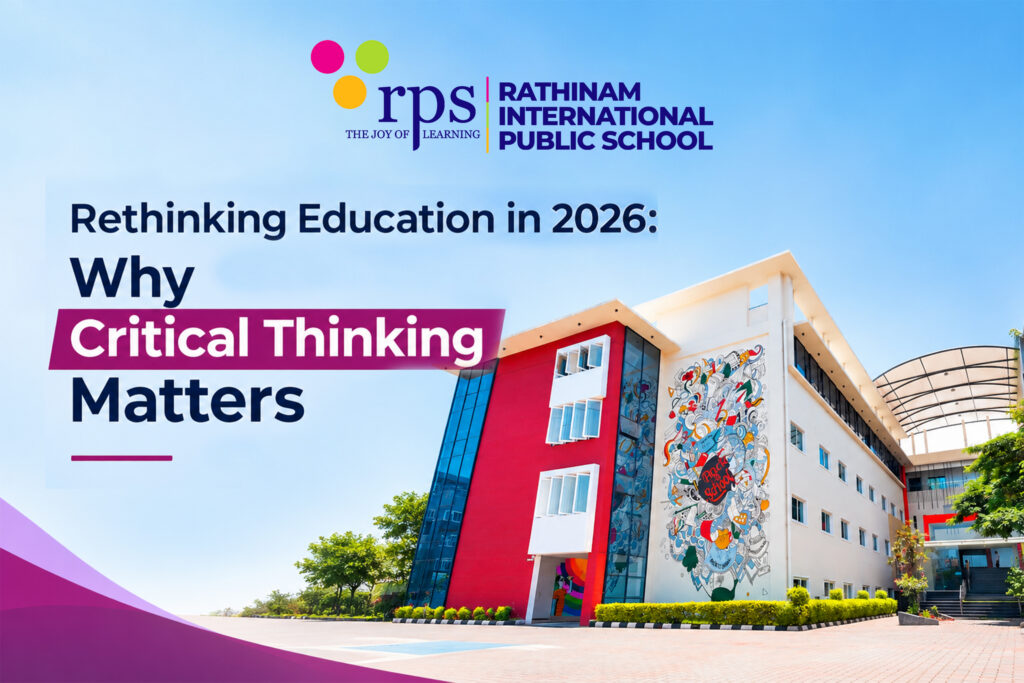
The traditional methods of learning tend to focus more on memorising and repeating what they have learnt. This encourages them to know about the “how” and “why” of the topic and its applications.
The emergence of the new educational model can be observed in Rathinam International Public School (RPS), where emphasis is placed on holistic learning and experiential learning.
Why is Critical Thinking More Important than Memorisation?
Memorisation will allow students some amount of recall but critical thinking will allow them to put it to use. Both are useful in education; it would be dangerous to rely solely on memorised responses.
Students are able to:
- Analyse information
- Solve problems
- Make informed decisions
- Be creative
- Develop confidence
How Modern Education Encourages Independent Thinking
Below are some ideas about how to foster critical thinking.
1. Inquiry Based Learning: Fostering Students’ Questions
The basis of inquiry-based learning is curiosity. The learner is supposed to pose queries, engage in analysis and investigate subjects, and come up with conclusions.
This will help to create:
- Curiosity and independent research.
- Logical reasoning and analytical skills.
- Better understanding of academic concepts.
- Confidence in expressing ideas and opinions.
2. Experiential learning: Learning through Experience
Experiential learning is an application of the classroom knowledge into practice. It is the learning of students by performing experiments and real-life demonstrations.
Benefits of this learning style include:
- Interest and independent study.
- Reasoning and analysis.
- More knowledge about academic terms.
- More confidence to voice one’s opinions.
3. Project Based Learning: Making ideas Practical.
Project based learning motivates students to be involved in research, planning and creative activities.
In the process of these activities they get to:
- Understand the problem and its causes.
- Obtain information and analyze ideas.
- Cooperate with peers for finding solutions.
4. Group Discussions and Team Work
Group discussion and team work help students to share their views and ideas. This is achieved by developing the following skills:
- Effective communication skills.
- Teamwork skills.
- Public speaking skills.
Schools in the Development of Critical Thinkers
Rathinam International Public School provides an integrated learning experience encompassing education, practical skills and academics.
A number of learning activities undertaken at school are:
- Innovation and Design Thinking Lab
- Atal Tinkering Lab (ATL)
- Digital Classrooms
- Language Labs
- Co-curricular Activities
Also check, 7 Reasons How RPS Expands Physical Activities Through Structured Systems
How Parents Can Encourage Critical Thinking at Home
Thinking critically is not confined to being a part of class alone. The parents can also help give the children occasions to see, ask questions, and think independently.
Here are some simple practices to help you:
- Encourage questions
- Discuss different viewpoints
- Introduce problem-solving activities
- Promote reading habits
- Appreciate independent efforts
- Allow mistakes
Conclusion
Through Rathinam International Public School’s holistic education system, which is research-based, experiential, collaborative and innovative, the students are able to develop into independent thinkers who are able to adapt themselves according to their surroundings.
An educational process should be such that it helps the students develop into individuals capable of questioning, decision-making, and being an active part of society.
FAQs
- What is critical thinking in education?
- It involves analysis, evaluation of ideas, problem identification and logical decision making. It aids the students to comprehend concepts, not merely remember.
- What’s the significance of critical thinking in secondary education?
- Critical thinking enables students to form their own conclusions, solve problems, be creative and communicate.
- How to build critical thinking skills in students?
- Inquiry-based learning, discussions, debates, experiments, project-based learning and collaborative assignments.
- What is the difference between memorisation and critical thinking?
- The process of memorization is the ability to memorize something while the ability to use knowledge in a variety of situations is called critical thinking.
- How does Rathinam International Public School promote critical thinking?
- We promote critical thinking through Inquiry-based learning, hands-on activities, project-based learning, digital classrooms, Atal Tinkering Lab and Innovation and Design Thinking Lab.
E-E-A-T
- Content Created by: Ghowthami M
- Reviewed by: Content Team
- Fact-Checked with: Official RPS Website
- Research Sources: Trusted Education Resources
- Published by: Rathinam International Public School
- Purpose: Parent Education & School Awareness
- Content Standard: Accurate, Clear & Parent-Focused
Source Links:
- https://rathinamschool.ac.in/
- https://www.thehindu.com/
- https://timesofindia.indiatimes.com/
- https://www.indiatoday.in/