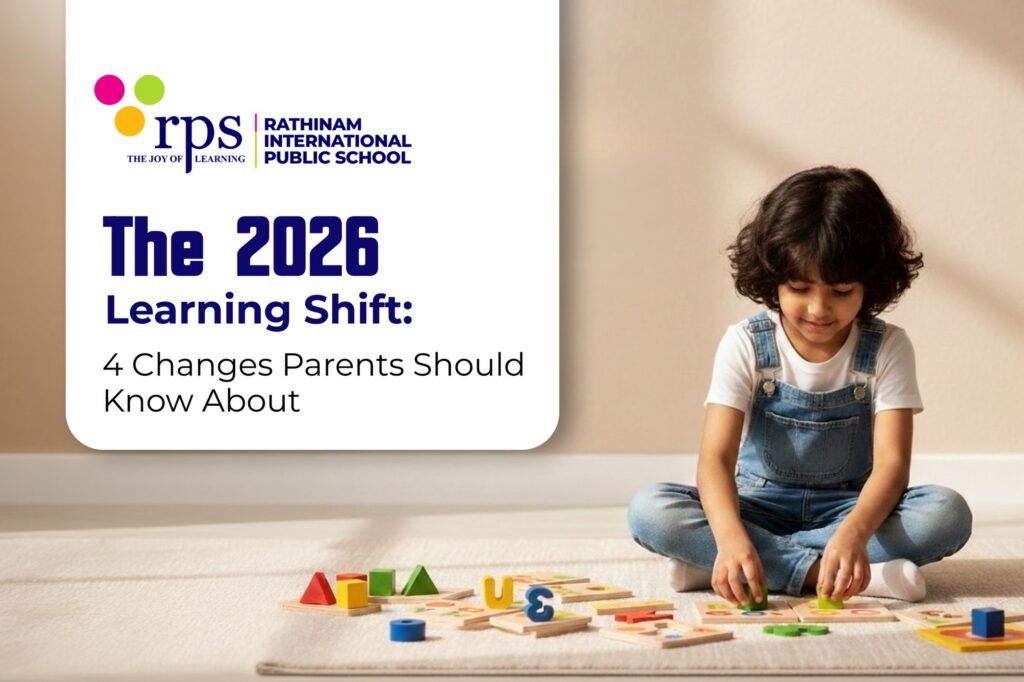
Parents are more aware that schools provide opportunities for children to think independently, communicate confidently, solve problems and apply their learning.
The discussion in education in 2026 is shifting from ‘What will my child learn?’ to ‘How will my child learn?’.
This change is seen at Rathinam International Public School (RPS) where learning is holistic and experiential, involving academics, technology, projects, creativity and collaboration.
The Shift Towards Smarter & Deeper Learning
1. From Memorising Answers to Learning How to Think
Inquiry learning at RPS fosters students’ curiosity, allows students to investigate, have a conversation and arrive at a decision based on the information they have.
This technique can be used to foster the following:
- Critical thinking
- Research skills
- Problem-solving
- Independent learning
- Curiosity
2. Classroom Theory to Real World Learning
Learning by doing is significantly gaining importance in today’s education system.
RPS combines hands-on and project-based learning to give students a chance to apply the concepts they’ve learned in the classroom to real-world and hands-on situations.
Skills that can grow through experiential learning
Learning Experience | Skills Developed |
Projects | Research & problem-solving |
Group activities | Collaboration & communication |
Experiments | Observation & application |
Presentations | Confidence & expression |
Real-world tasks | Practical thinking |
3. From Technology as a Tool to Technology as a Learning Experience
Technology-enabled learning can support:
- Digital literacy
- Logical thinking
- Creativity
- Experimentation
- Research
- Problem-solving
- Technology awareness
4. From Academic Scores to the Whole Child
RPS has a holistic approach, academic learning along with social-emotional development, physical development, creative expression and communication. In addition, there are activities for it like sports and other co-curricular experiences.
Academics + Skills + Creativity + Communication + Well-being = Holistic Development
RPS involves play and hands-on activities for younger learners. In subsequent years, the curriculum focuses more on critical thinking, communication, collaboration, digital literacy and independent inquiry.
Also check, How Post-School Activities at RPS Build Future-Ready Students
What Should Parents Look for in a School in 2026?
What to Look For | Why It Matters |
Strong academics | Builds subject knowledge |
Experiential learning | Connects theory with practice |
Project-based learning | Encourages application |
Technology exposure | Builds digital awareness |
Communication activities | Develops confidence |
Sports & creative activities | Supports balanced development |
Collaborative learning | Builds teamwork |
Critical thinking | Encourages independent thought |
RPS combines various elements in its student-centred approach, digital classrooms, hands-on activities, Innovation & Design Thinking Lab, ATL exposure, project-based learning and co-curricular opportunities.
The 2026 Parent Checklist
When visiting schools, inquire:
- Does my child get opportunities to ask questions?
- Learning relates to life experiences?
- Does the school encourage creativity and problem solving?
- Is technology used meaningfully?
- Is communication and collaboration an element of learning?
- Is academic and personal achievement pursued side-by-side?
The above questions will help parents to see beyond the facilities to what their child is learning.
Conclusion
The classroom of 2026 is becoming more interactive, collaborative and experience-oriented.
Rathinam International Public School’s emphasis is on learning with innovation, application, creativity, technology and integrated development; where students can discover ideas and develop skills for the new world.
Admissions Open 2026-27!
FAQs
- What will be different in schools in 2026?
- Experiential learning, project based learning, technology, critical thinking, communication and holistic development are being integrated in educational processes.
- What is the reason why experiential learning is important for children?
- The method of combining concepts with experiences. Learning is integrated with practical and real life learning in RPS.
- How does RPS incorporate technology into learning?
- RPS is utilizing digital classrooms and blended learning and has introduced students to AI and Robotics in its ATL.
- Is today’s education just about technology?
- No. Technology is not the only component of contemporary education. Other significant factors are communication, creativity, collaboration, critical thinking, and physical development.
- When parents are choosing a school, what should they take into account?
- Parents can view the curriculum, teaching practices, academic base, learning opportunities, using technology, communication opportunities, co-curricular activities and the approach to child development in the school.
E-E-A-T
- Content Created by: Ghowthami M
- Reviewed by: Content Team
- Fact-Checked with: Official RPS Website
- Research Sources: Trusted Education Resources
- Published by: Rathinam International Public School
- Purpose: Parent Education & School Awareness
- Content Standard: Accurate, Clear & Parent-Focused